Good habits are very important in life. They are instilled mostly during childhood and stay with us till the end. Good habits usually refer to your moral conduct and also your way of living. It is the way you treat others and behave with them. Being polite and considerate toward others is considered a good habit. If you meet others with a smile and treat everyone with respect then you have good social habits. Apart from good social habits, how you treat yourself and your surroundings also matters. Keeping yourself neat and tidy always is considered a good habit. Similarly, if you keep your room clean and tidy, it is also a good habit. Brushing your teeth twice daily, clipping your nails from time to time, not littering are some of the good habits. Likewise, there are many good habits that one can possess. These habits shape up your complete personality and define who you are and how you are. The society we live in, value good habits and acknowledge it.
Be proactive
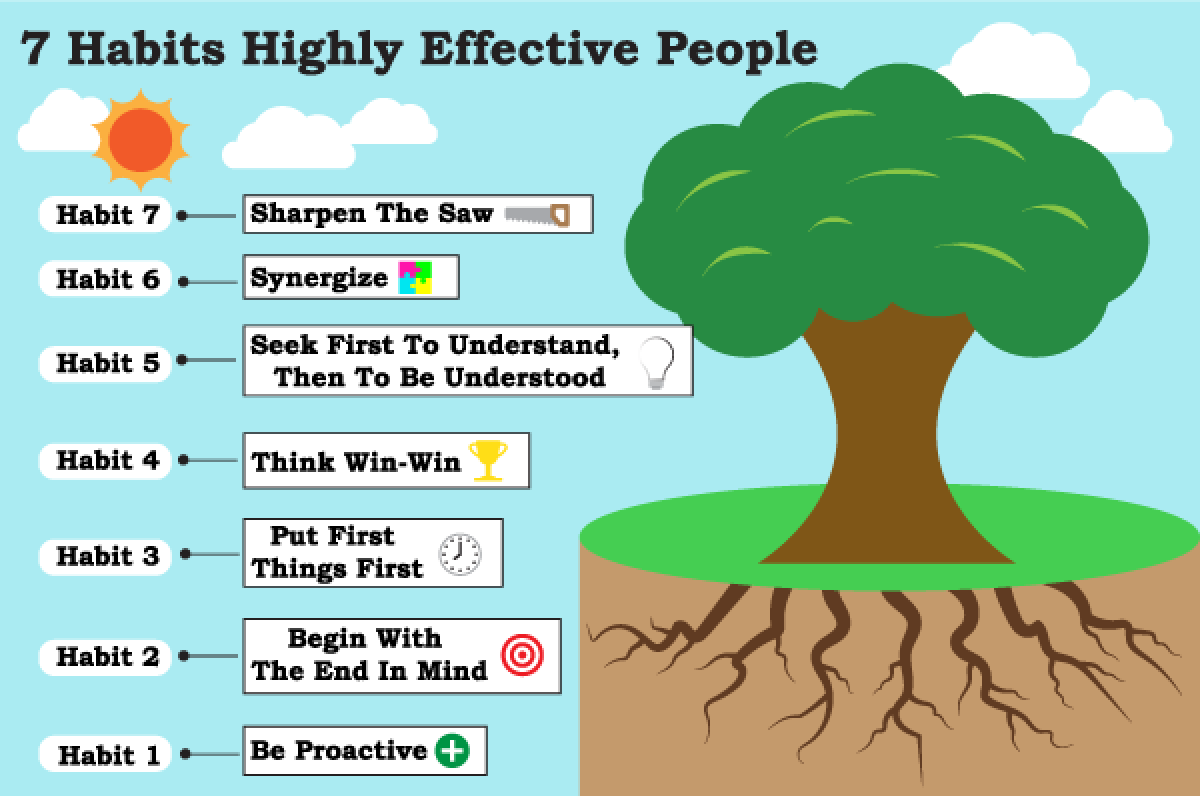
Take responsibility for your reaction to your experiences, take the initiative to respond positively, and improve the situation. Recognize your Circle of Influence and Circle of Concern. Focus your responses and initiates on the center of your influence and constantly work to expand it. Don't sit and wait in a reactive mode, waiting for problems to happen (Circle of Concern) before taking action.
Begin with the end in mind Envision what you want in the future so you can work and plan towards it. Understand how people make decisions in their life. To be effective you need to act based on principles and constantly review your mission statements. Are you - right now - who you want to be? What do I have to say about myself? How do you want to be remembered? If habit 1 advises changing your life to act and be proactive, habit 2 advises that you are the programmer! Grow and stay humble. All things are created twice. Before we act, we should act in our minds first. Before we create something, we measure twice. This is what the principle is about. Do not just act; think first: Is this how I want it to go, and are these the correct consequences?
First things first
Talks about what is important and what is urgent. Priority should be given in the following order (in brackets are the corresponding actions from the Eisenhower Matrix):,
Quadrant I. Urgent and important (Do) – important deadlines and crises
Quadrant II. Not urgent but important (Plan) – long-term development
Quadrant III. Urgent but not important (Delegate) – distractions with deadlines
Quadrant IV. Not urgent and not important (Eliminate) – frivolous distractions
The order is important; after completing items in quadrant I, we should spend the majority of our time on II, but many people spend too much time in III and IV. The calls to delegate and eliminate are effective reminders of their relative priority.
If habit 2 advises that you are the programmer, habit 3 advises: write the program, become a leader! Keep personal integrity: what you say vs what you do.
Think win-win
Genuine feelings for mutually beneficial solutions or agreements in your relationships. Value and respect people by understanding a "win" for all is ultimately a better long-term resolution than if only one person in the situation had gotten their way. Think Win-Win isn't about being nice, nor is it a quick-fix technique. It is a character-based code for human interaction and collaboration.
Seek first to understand, then to be understood
Use empathetic listening to genuinely understand a person, which compels them to reciprocate the listening and take an open mind to be influenced by you. This creates an atmosphere of caring, and positive problem-solving.
Habit 5 is greatly embraced in the Greek philosophy represented by 3 words:
1) Ethos -- your personal credibility. It's the trust that you inspire, your Emotional Bank Account.
2) Pathos is the empathetic side -- it's the alignment with the emotional trust of another person's communication.
3) Logos is the logic -- the reasoning part of the presentation.
The order is important: ethos, pathos, logos -- your character, and your relationships, and then the logic of your presentation.
Synergize
Combine the strengths of people through positive teamwork, so as to achieve goals that no one could have done alone.
Sharpen the Saw; Growth
Balance and renew your resources, energy, and health to create a sustainable, long-term, effective lifestyle. It primarily emphasizes exercise for physical renewal, good prayer (meditation, yoga, etc.), and good reading for mental renewal. It also mentions service to society for spiritual renewal.
Covey explains the "Upward Spiral" model in the sharpening the saw section. Through our conscience, along with meaningful and consistent progress, the spiral will result in growth, change, and constant improvement. In essence, one is always attempting to integrate and master the principles outlined in The 7 Habits at progressively higher levels at each iteration. Subsequent development on any habit will render a different experience and you will learn the principles with a deeper understanding. The Upward Spiral model consists of three parts: learn, commit, do. According to Covey, one must be increasingly educating the conscience in order to grow and develop on the upward spiral. The idea of renewal by education will propel one along the path of personal freedom, security, wisdom, and power.
Previous page Back to homepage Next page